
Taking Prayer to the Next Level

Photo by Ben White on Unsplash

Prayer is communication with God. We talk to God, and we listen as well. If we’re not doing both, it isn’t prayer; it’s a dramatic monologue. But sometimes we might feel as if our prayers are going nowhere. This isn’t true, of course. Our prayers don’t have to “go” anywhere. God lives within us. He knows our thoughts, so He very clearly hears our prayers. We know the truth of the matter from God’s Word, but there may be times in our life when we feel like our prayer life needs to be taken up a notch. Maybe we need to hear from God in a really big way, and our normal daily prayer doesn’t seem to be enough. There’s just too much noise.

Well, the best way to take our prayer level up a notch is by including the spiritual discipline of fasting. Let’s be clear, fasting doesn’t move God. God isn’t some genie in the sky who can be manipulated by your acts. What fasting does is remove the background noise of our lives. It strengthens our inner spirit man, giving our spirit dominance in our lives. When we remove the background noise, when we exercise self control and give our spirit dominance, we remove obstacles to receiving from God.

Fasting used to be a given. Jews regularly fasted at special times of the year. The early church fasted once a week. Catholics still fast during lent and advent. Protestants, on the other hand, don’t necessarily speak a lot on fasting. Fasting has become a personal choice. As a result, it can be hard to know the basics about fasting. How do you fast? When should you fast? Why should you fast? What does fasting do?

Fasting is going without food for a given amount of time. There’s no hard and fast rules on how long you should fast for, but the shortest period of fasting is typically 24 hours and the longest is typically 40 days. Fasting takes the time you would normally spend preparing and eating food and spends it on prayer and contemplation of God and meditating on His Word instead. Just going without food isn’t enough. If all you’re doing is skipping meals and not using that time for prayer or contemplation, then you’re on a diet, not a fast.

The purpose of a fast is to subject your body to the will of your spirit. By ignoring your body’s desire for food, you are telling your body that your spiritual needs are more important. Turning that time over to prayer and meditating on the Word of God, strengthens you spiritually. Paul talks about disciplining our bodies, making them our slaves so that we might win the prize that God has for us. How do we make our bodies our slaves? We control our natural appetites. We focus instead on spiritual things.

There are several ways you can go about fasting. You may choose to fast for 24 hours on a more frequent basis like once a week. You might decide to fast from sunrise to sunset, eating one meal only after the sun has set each day. You might decide to give up all food and only drink water and fruit juice, or you might drink only water. You may decide to give up all food and all water as well. You might decide to follow a Daniel Fast, giving up certain types of food for a period of time. Daniel fasts are usually done for 21 days and up to 40 days. If you’re contemplating undergoing one of the more extreme fasts, be sure to do so only after preparation and consultation with your doctor.

What if you can’t fast from food? There may be times when you want to experience the spiritual benefits of fasting, but you can’t fast from food. If you have certain medical conditions or if you are pregnant or nursing, fasting may pose too high a health risk. You can still get the benefits of a fast without giving up food by giving up something else that takes a lot of your focus and energy. You might fast from TV, from certain hobbies or activities, or from social media. Take the time you would normally spend focused on these activities and instead use that time for prayer and meditating on God’s Word.

It isn’t WHAT you give up that’s important. Rather, it’s the act of self discipline it takes to deny your body and the signals it is sending you about your comfort level and your needs and instead putting your spiritual needs in charge. It’s your attitude in fasting that’s important here. In fact, all of Jesus’ instructions to His disciples about fasting involve the motivation of the fast rather than the details of the fast. Remember, God looks on the heart.

Again, fasting isn’t about earning ultra-spiritual brownie points with God. It isn’t about earning blessings or getting God to do something for you. God already loves you deeply and unconditionally. In fact, there’s nothing you can do to make God love you any more than He already does. Just like there’s nothing you can do to make Him love you any less. You don’t have to earn God’s favor. He’s already given it to you by grace. God has already supplied us with every spiritual blessing. Instead, fasting is for you. It’s a chance for you to quiet the noise and distractions around you in order to tune in to what God is saying to you. Fasting is the like the old school antennas on a TV. It helps you adjust your reception so you can receive what God is already broadcasting. So when you find yourself in a situation where life seems a bit too loud and you need to hear from God, consider joining your prayer to fasting, and take your prayer life to the next level.

Help! I’m Sinking!

Photo by Hayley Catherine on Unsplash

Psalm 40: 1-3

“I waited patiently for the Lord; he turned to me and heard my cry. He lifted me out of the slimy pit, out of the mud and mire; he set my feet on a rock and gave me a firm place to stand. He put a new song in my mouth, a hymn of praise to our God. Many will see and fear the Lord and put their trust in him.”

How many times have you felt like you’re in over your head? Felt overwhelmed? Like you’re sinking into depression or just bad circumstances? David certainly felt this way. David was often pursued by enemies. His life was in danger multiple times. And David wasn’t perfect. Even though he was a man after God’s heart, he still committed sins, like adultery and murder. I’m sure there were many times in David’s life where it felt as if he were sinking in mud. But David recognized that God was there even in those circumstances.

When David called out to God, God answered him. He didn’t leave David alone in desperate circumstances. He didn’t leave him to fend for himself. Instead, God rescued David. He put David’s feet upon a rock. God does the same for us. When we feel ourselves sinking, we can stand on the rock of the God’s promises to us in His Word. There is a promise for every situation we face. Standing on that promise, suddenly we have sure footing again. We know that we can rise above the circumstances we find ourselves in. We know that we are more than conquerors.

When we find ourselves standing on the firm rock of God’s Word, we can’t help but sing for joy. We can’t help but shout about how God rescued us, how He saved us, How he provided for us. We are an example to others because we testify to what God has done in our lives. So if you find yourself sinking in the circumstances of life, call out to God. Seek His Word and promise for your life in that situation, and then praise Him for providing a firm foundation for you to stand on!

Father, I thank you that you are the God who never leaves me or forsakes me. There’s never a circumstance I find myself in where you are not able to reach me and rescue me. Thank you for your Word which provides a firm foundation for me to stand on. You have made me more than a conqueror because of your promises in your word to me. When I find myself sinking, I will call to you, and you will come and set me on sure ground again. Thank you, God. In Jesus’ name, Amen.

The Sovereignty of God

Photo by Markus Spiske on Unsplash

God is sovereign. “Duh,” you may be thinking. “Why are you telling me this?” Well, believe it or not the sovereignty of God is a topic of intense debate. Ask someone what it means that God is sovereign and you’re likely to get different answers depending on whether or not you’re speaking to a Catholic, a Protestant, a Calvinist, or an Arminian. Don’t know what that means? That’s okay. You don’t have to understand the terms to understand the concept that different people have different beliefs and understandings about what it means that God is sovereign. About the only thing all these groups agrees on is that if you don’t have the right understanding of God’s sovereignty, you don’t have the right understanding of who God is. If you don’t have the right understanding of who God is and how He works, that has serious implications for your spiritual life. Some even believe it can jeopardize your salvation. Wow! That’s pretty heavy stuff.

So let’s start with the basics. What does the word “sovereign” mean? According to Webster’s Dictionary, sovereign means: 1) one possessing or held to possess supreme political power or sovereignty (we’ll cover this definition in a minute). 2) one that exercises supreme authority within a limited sphere 3) an acknowledged leader. Sovereignty means: 1) supreme power especially over a body politic. 2) freedom from external control. 3) controlling influence. So if God is sovereign, we accept all these premises about Him. The Christian belief in what that means at a practical level is where things get a bit more interesting.

Basically, Christians believe that the sovereignty of God means that God is the supreme authority and all things are under His control. So far so good. The issue comes when you try to reconcile a God who controls everything with things like free will and salvation. Some extreme views of God’s sovereignty say that everything that happens was foreordained and planned by God. Nothing happens that God did not either directly cause to happen or allow to happen. This view sounds great on the surface, but when you look a little deeper the cracks begin to appear.

If nothing happens that God did not either directly cause to happen or allow to happen, then God is responsible for a lot of bad things. God is either causing natural disasters or allowing them to happen. He’s at best allowing terrorism to exist and allowing murder to occur. That doesn’t really sound like a loving, merciful God. In fact, this view is what makes most people pursue atheism. They say things like, “I don’t want to serve a God that allows all these bad things to happen.” I don’t blame them! But the Bible doesn’t say that God allows bad things to happen or that He causes bad things to happen. It doesn’t say that at all. In fact, it describes God as merciful, loving, slow to anger. Jesus says He came to give us life. It’s the devil that’s out to steal, kill, and destroy.

You may think that you don’t hold this view, but I bet it’s crept into your thinking a time or two. When you’re trying to understand something difficult? When someone dies young? When a tragedy happens? It’s easy to say that God did it, or that God controlled it happening. That takes the blame off of any personal responsibility and places it firmly on God’s shoulders. And, honestly, it’s easier to believe that than to understand why things happen that are against God’s will if He is sovereign.

But the Bible says that lots of things happen against God’s will. It comes down to this key in the definition of sovereignty: legal authority. God is a law-abiding god. It’s part of who He is. He is holy. He puts certain laws into place, and He abides by those laws. That’s part of His nature. When He created the world, He passed that legal authority on to Adam and Eve. He didn’t intervene when they were being tempted by Satan because Adam and Eve had the legal authority. To intervene at that point would be to undermine that authority. It would break the law. It would invalidate free will. So God in His sovereignty limited Himself by allowing free will and legal authority to take place. It wasn’t God’s will that Adam and Eve sin. If it were, then there wouldn’t have been a consequence to their sin. After all, they would have still been in the will of God. How can God punish people for sin if sin is His will? The obvious answer here is that they were NOT in the will of God. Sin was NOT God’s will or plan.

When Adam and Eve sinned, they passed their legal authority on to Satan. So sin and sickness and disease and deception and all kinds of things against the will of God were released into the world. Because Satan had the legal authority, all God could do was operate according to the law. Sacrifices for atonement could be made. That sacrifice would cover the sin and allow God to act on behalf of the person offering them. Ultimately, the sacrifice of Jesus Christ accomplished this atonement once and for all. When we are saved, we take back our dominion from Satan on the basis of this atonement. We’re not slaves to sin any longer. We’re not under Satan’s legal control. We hand the dominion back to God.

God CAN step in and act contrary to our faith and contrary to certain spiritual laws. He has the ability. Some could argue He has the ultimate authority. But He won’t. He won’t because free will is very important. God didn’t create us so that we could do nothing but worship Him. He created us so that we would CHOOSE to worship Him. Loving someone by choice is much more powerful than loving someone because you have no other choice. So God won’t violate your free will. He won’t violate what you ultimately believe. God is not mad at you. He isn’t holding your sin against you. All sin that would ever be committed, was ever committed, could ever be committed was atoned for by the finished work of Jesus on the cross, but you don’t automatically get salvation just because Jesus died on the cross. You have to receive that gift. You have to appropriate it for yourself. You have to use faith.

There is a balance to the sovereignty of God. There are spiritual laws in place that He follows. It’s important to understand that sovereignty for what it is and what it means. We’re told to resist the devil, but if we think that sickness and trials and temptations are God’s will, how can we resist them? This is what James is talking about when he says that a double-minded person does not receive from God. You can’t pray for healing while believing God sent sickness to teach you a lesson. God doesn’t send sickness. It’s not His will. The Bible makes that clear.

But sickness comes all the same because we live in a fallen and broken world. God can use that sickness. He can turn it for good. You can exercise your spiritual muscles and put into practice the fruits that God has already put inside you. But that’s not the same thing as causing it to happen or even allowing it to happen. Study this out for yourself. Search the Scriptures for references to God’s sovereignty and our choice and responsibility. It’s important that you understand what God’s will IS and also how to access that for your life. It’s important that you understand WHO God is. It makes a huge difference to how spiritual blessings will manifest in your life.

Who Are You Listening To?

Photo by Ben White on Unsplash

Our brains are like sponges. We are constantly soaking up information from the world around us. Some of this information comes to us from our five senses. Our bodies are designed to use these senses to gather information from our environment. They filter this information to our brains, and then our brains process that information and decide what to do about it. That system works great for some things, but not so great for others. For example: If there is a fire, your nose smells the smoke. Your eyes may see the fire and/or the smoke. Your skin may register heat from the fire. All that information goes to your brain, which processes that a fire is present and tells you to put it out or get out of danger. But what if your brain is receiving information that isn’t true? Well, then the things your brain tells you to do with that information wouldn’t be true either or helpful.

God designed us to process information through our five senses. In the garden, our senses gave us information that was untainted, and we processed that information with our brains and with God. Remember, Adam and Eve walked with God every day. So if information came in that was confusing or different or new, they could take that information directly to God and receive the meaning of that information from Him. Since God is Truth, they would always be relying on a source of truth for interpretation of the world around them.

But when Adam and Eve sinned, things got complicated. Satan tempted Eve with the idea of knowing good and evil for herself, apart from God. Instead of going to God as the final judge of information, Satan was offering Eve the opportunity to be her own source of final judgement. Now, all the incoming information Adam and Eve processed was being run through their own faulty filter of good and evil. They were interpreting the information for themselves. They weren’t going to the source of Truth for how to interpret that information.

That’s the situation we find ourselves in today. Our senses supply us with information. We could refer to that information as “facts.” Facts are neither good nor bad. They just are. It’s what we do with those facts that makes a difference. How are we interpreting those “facts”? What source are we plugging into? In essence, who are we listening to? Satan loves to have us in this position because he can take those “facts” of what our senses are telling us, add a bit of a lie to them, and have us trapped in strongholds within our mind.

Let’s look at how this might play out in our lives. We walk into the office one morning. Our coworker doesn’t even look up or acknowledge our presence. The “facts” that our brain receives are: 1) Our coworker is present. 2) Our coworker doesn’t look up. 3) Our coworker doesn’t say “hi.” Those are the facts. Our brain then processes those facts through the filter of our experience. If we’ve had a bad experience in the past, our brain is going to interpret those facts through the lens of the bad experience. If I’ve experienced rejection before, then I might think my coworker is rejecting me also. I might believe she intended to ignore me, that she doesn’t like me, that I’m “invisible” or “worthless,” etc. All kinds of thoughts can go through my mind attributing significance to the simple fact that my coworker didn’t look up and say “Hi.” But none of those thoughts may be true. The Truth is that I don’t actually know anything about my coworkers motivation, and I’m probably unlikely to ask. I have served as my own judge on this matter. I have determined my own truth, tainted by sin. I have listened to my own authority. I have begun the process of allowing Satan to build a stronghold in my life.

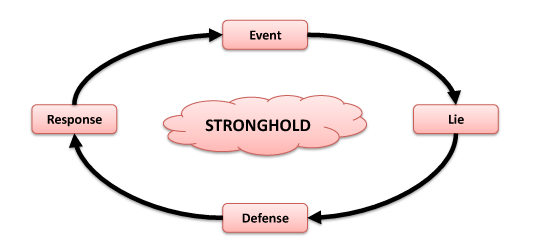
What’s a stronghold? A stronghold is a wrong pattern of behavior or a pattern of thinking that is contrary to the nature of God and the Kingdom of God. Strongholds are rooted in the Devil’s lies. Here’s what a stronghold looks like:

Something happens. That’s the event. In our scenario above, it’s walking into the office and my coworker not acknowledging my presence. That leads to the lie. The lie is Satan’s interpretation of the event. It’s always negative. We assign a negative meaning to what happened. In this case, the lie I attach to this event is that my coworker doesn’t like me and is rejecting me. That brings me to the defense stage. In the defense stage, I act on the lie I have believed. Maybe I refuse to talk to this coworker. Maybe I build up walls of protection around myself so that this coworker can’t hurt me in the future. Defense is my attempt to take control of my life as a result of believing this lie. That leads to the response. The response is others reactions to my defense. If I stop talking to this coworker, they probably won’t reach out to talk to me. They may think that I don’t like them just the way that I thought they didn’t like me when this whole pattern started. Because they aren’t reaching out to me, I’m back at event. They aren’t talking to me. And the whole thing starts again. I’m trapped in a pattern of behavior and thinking that has me feeling stuck.

God has the answer to this, of course. 2 Corinthians 10:4-5 says “The weapons we fight with are not the weapons of the world. On the contrary, they have divine power to demolish strongholds. We demolish arguments and every pretense that sets itself up against the knowledge of God, and we take captive every thought to make it obedient to Christ.” Adam and Eve made the choice to unplug from God as the final source of knowledge and judgement of good and evil. We can, likewise, make a choice to unplug from ourselves as the final source of knowledge and judgement and instead plug into God as our final source.

Most people tend to think that they are struggling because of the negative event. They think that they are trapped by the negative things that happened to them in the past. If that were true, freedom would never be possible because we can’t time travel back to the past to undo the event. What we CAN do is attack the lie that we have associated with the event. How do I tear down the lie?

First, I have to identify the lie I have believed. Once I start thinking about the struggles in my life, it might become obvious what the lie is, but if it’s not obvious I can go to God and ask Him to reveal the lie to me. This puts God back as my source of information. I’m not trying to do this on my own power or in the flesh; I’m relying on God to be my source of information, Truth, and strength.

Next, I have to confess and receive forgiveness. Ultimately, by allowing Satan to dictate how I viewed the event, I have placed an idol in the place of God. I have looked to someone or something other than God to be my source. I have made Satan and his lies the final word on how I view the events in my life. So I need to confess to God that I have believed a lie and put Satan in charge, and then I need to accept the forgiveness God offers me for that. I don’t have to feel condemned or beat myself up for doing this. I just need to acknowledge what has happened, confess that it happened, and hand it to God.

Third, I need to renounce the lie. It’s all well and good to confess that I have believed a lie, but I have to go a step farther and renounce and reject the lie that I have believed. I need to actively speak against that lie, stating that I know it to be a lie and that I will no longer believe it. Most negative events involve other people, and so while I’m rejecting the lie I have attached to the event, I need to also forgive anyone involved in that event. Forgiveness doesn’t erase the event. It doesn’t say that what happened is okay, but it does release me from having to hang onto those negative feelings. It puts the event in God’s hands and allows Him to handle making it right.

Finally, I need to ask God to show me the truth. I need to let God show me how He viewed the event that happened to me. I need to see how He sees me. I need to get my Truth directly from the source of all Truth, which is God. When a negative event happens, I can stop right then and ask God to show me the Truth about this event. In the case of my coworker ignoring me, if I stop and ask God He may say things like “Your coworker is just preoccupied with work. She isn’t rejecting you.” or He might say, “I accept you no matter what. You are the apple of my eye, and My opinion of you is the only one that matters.” Hearing the truth from God allows us to reframe the event in our minds. We need to replace the lie we believed in the past with God’s revealed truth, and we need to confess that truth over our lives from that point forward.

When we accept God’s truth as the final word on the matter, we no longer need to defend ourselves. We put out defense in God’s hands. We let His opinion of us be the only one that counts. If God is for me, who can be against me? I don’t have to protect myself from hurt because God will protect me. Now my defenses start to come down as I begin to see myself the way God sees me and allow Him to protect and defend me. When my defenses come down, the way others react to me also changes. This leads to positive events, or at least positive interpretations of the events that happen. I’m no longer seeing life through that lens of hurt and pain. Now the cycle has flipped. I’m not caught in a stronghold any longer. I’m set free!

God wants us to experience freedom. It’s part of His mission to destroy the works of the enemy. If you’re struggling with freedom in an area of your life, ask God if you might be dealing with a stronghold. Take those negative thoughts captive. Hold them up to what God’s Word says about you and about your situation. Let God reveal to you the Truth. Make Him your final source.

Shine On

Photo by Lucas Benjamin on Unsplash

Isaiah 60:1-2

“Arise, shine, for your light has come, and the glory of the Lord rises upon you. See, darkness covers the earth and thick darkness is over the peoples, but the Lord rises upon you and his glory appears over you.”

We’ve all heard of the Dark Ages, that period in history where the light of science and knowledge was absent, but spiritually some of us are still living in the Dark Ages. Satan loves darkness, and he loves to keep us in that darkness, but Jesus came as the Light of the World. Jesus came to bring light to the darkness and drive it away.

Do you remember the story of Moses on Mount Sinai? The children of Israel had crossed through the Red Sea and stopped at Mount Sinai. The Lord agreed to meet with Moses on the top of the mountain and give him the law and further instruction for the people on the way to the Promised Land. Moses went up on the mountain and spent time in the presence of the Lord, and when he came down his face glowed. It glowed!

You and I were created to reflect the image and glory of God. We were made in his image. When we spend time with God, when we allow His light and glory to be around us, we start to reflect that same light and glory. That’s what Isaiah, the prophet, saw when he wrote these lines: Arise, shine, for your light has come. Which light? The Light of the World, Jesus Christ. Jesus has come. We are in relationship with Him as soon as we are saved. In that close proximity, we reflect the light of Jesus to the world around us. It’s our job to reflect Jesus to the dark world we live in. The world won’t see that light any other way until Jesus comes again.

So, Arise. Shine. Reflect the glory of God to the darkened world. Reflect it to you neighbor. Reflect it to your coworker. Reflect it to your family. Spend time with Jesus until your face glows! Then the world will see Jesus in you.

Father, I thank you that you sent your Son, Jesus, to be the light of the world. I thank you that I have the privilege of being in relationship with you and with Jesus. Father, I know the more time I spend with you, the more I will become like you and reflect your glory to the world around me. God, I know people in my life that need your light. They are living in darkness, Lord. Help me to be a reflection of your light in their lives. Help them see Jesus in me, so that they will want to have a relationship with you, too. In Jesus’ name, Amen.

Who’s In Charge Here?

Photo by Christopher Sardegna on Unsplash

Proverbs 16:9

“In their hearts, humans plan their course, but the Lord establishes their steps.”

We all have a tendency to think that we’re in charge. We are the captain of our ship so to speak. We spend a lot of our time planning the direction we want our lives to take and moving toward those goals, but Proverbs reminds us that we aren’t actually in control of anything. We can plan all we want, but it is the Lord who controls our steps. We can spend our time fighting against the Lord’s will for our lives, or we can cooperate with His plans and let Him take us to amazing places we never dreamed possible.

God isn’t telling us not to plan. The Bible isn’t saying that we have no free will or that we’re all supposed to operate like robots. Instead, Proverbs is encouraging us to take our plans to the Lord, to work with Him on our direction in life, and ultimately to realize that when our steps take us to a place we didn’t see coming, God is there with us. Sometimes our steps lead to a place of suffering, and we can feel blindsided by the circumstances we’re in and feel utterly alone.

But the truth is that God has brought us to this place, either as a result of our own choices or just because He has a greater purpose in it, and when we trust that He is with us, directing our steps, we can let go of the anxiety and pain of the unknown. We can trust that no matter where we go, whether it’s in our plans or not, that we are never alone. God is always with us. He is always willing to draw us back to Himself and the path He has for our lives.

Father, Thank you that you are ultimately in control of my life. I don’t have to worry when I reach a valley I didn’t anticipate or find myself in a circumstance I didn’t see coming. I know that you are always with me, preparing a way for me. Help me to bring my plans to you, Lord. Help me to partner with you in the direction of my life. I know you have only good things planned for me, Lord. In Jesus’ name, Amen.

You Can’t Give What You Don’t Have

Photo by Gregory Culmer on Unsplash

As moms we want to give our kids the best. Sometimes, though, the best does not include our best. We recognize that our kids need us to care for them. We spend our time trying to meet all their needs and even a large chunk of their wants, but we forget that we are human, too. As humans, we have needs. Even when we’re an adult. Even when we’re a busy mom. How often are we neglecting our own needs to meet everyone else’s needs? If you’re anything like me, the answer is: most of the time. We’ve all probably heard about self care. It’s been trending for a while now. There are all kinds of books on the topic, but many of us aren’t doing self care, don’t know what self care is, can’t figure out how to make self care happen with young children, and may even feel depressed and overwhelmed just thinking about it.

So let’s start at the top: What is self care? According to Marcia Baratta, Ph.D. L.C.S.W., “Self care in essence is the mindful taking of time to pay attention to you, not in a narcissistic way, but in a way that ensures that you are being cared for by you.” You are a spirit. You live in a body, and you have a soul (mind, will, and emotions). When you’re at your best, you are meeting the needs of all three, but many times we neglect certain needs because we think we don’t have time or we are just too busy. Not taking care of all of our needs can lead to burn out, illness, high stress levels, etc., and it sends a terrible message to our kids. A message we don’t even realize we’re sending: Your needs are not as important as everyone else’s needs. To our daughters we may be sending the message that they need to exhaust themselves tirelessly serving others in order to be successful women.

So what are some of our needs? According to Nurturing Parenting, our needs fall into six categories: Social, Physical, Intellectual, Creative, Emotional, and Spiritual. They use the acronym SPICES to help remember these categories. Social needs are things like the need for friendship and community. Physical needs include food, water, air, sleep, sex, and exercise. Intellectual needs are needs associated with the stimulation of new ideas and thoughts. Creative needs are needs that express one’s inner self. Emotional needs involve the need for love, praise, security, trust, and other emotions. Spiritual needs address belonging/membership and our relationship with God. As humans, we all have these needs. These needs don’t change as we get older, although the way we meet them, how much value we place on them, and how often we practice meeting them usually does.

Think of yourself as a battery. You have a certain amount of energy each day to devote to the things you want to do. If you recharge your battery throughout the day, you’ll constantly have full reserves to meet whatever challenges you face, but if you allow your battery to be drained and never charge it, eventually you won’t have the energy necessary to do even small tasks. Self-care refers to those activities that “recharge your battery.” It means meeting your needs in a way that allows you to reduce your stress, feel energized, and stay healthy. Self care isn’t selfish care. It isn’t putting your needs above the needs of everyone else. Instead, self care is about making sure you have the ability to do what you need to do. It’s treating yourself with the same compassion and care that you give to your children.

If you’re like me, you’re probably into the idea of self care. You probably recognize that you need to be your best in order to give your kids the best. But you probably also come away from most self care articles feeling like it’s never going to happen, especially if you have multiple children or very young children at home. Heck, I can’t even go the bathroom by myself most of the time without someone on the other side of the door asking me what I’m doing and when I’m going to be done! Don’t worry. There ARE ways you can meet your own needs without needing a huge amount of alone time or neglecting your many duties.

  1. Take advantage of unconventional ways to talk to friends. I’m thinking Facebook, text, or even email. If you have the time, see if you can find a MOPS group, a Bible study with childcare, or even set up play dates with other moms. You need the interaction with people who are not your children. It doesn’t have to be huge. Take some time to make small talk while you stand in line at the check out. Chat with your neighbor over the fence while your kids play outside. Strike up conversation with another mom at the park. Just connect with someone.
  2. Get some sleep. Yes, I know. In the early years, sleep comes at a premium, but you can be intentional about getting as much sleep as you possibly can. If you are mom to a new baby, sleep when baby sleeps. Every experienced mom will tell you this. Let some things go if you have to, but take advantage of longer naps to make up for your interrupted sleep at night. In the toddler years, nap when they nap. If you have a mix of older and younger kids, making nap time a mandatory quiet time for everyone in the house can give you a rest break as well. You may not get sleep, but you can get some peace and quiet to help reduce your stress. Ask your spouse for a nap break. My husband is a truck driver. That means that during the week, and sometimes up to two weeks or more, I am on call 24/7 as mom without any backup. When he’s home, though, hubby knows that I am off duty. I take that time to do some self care and catch up on sleep. He is very protective of my right to do this, too, which definitely helps. If I’m in a pinch when he’s on a longer run, I will sometimes call a friend or find a drop off program I can take the kids to while I take a much needed nap. Get creative if you have to, but try to get as much sleep as you possibly can.
  3. Get out and about. Taking the kids to the park or the store or the library or anything that gets you out of the house can help recharge your battery. It offers you a change of scenery and may even give you the opportunity for some exercise. The fresh air can help lift your mood, and it’s a great way to get rid of cabin fever in the winter time. Doesn’t have to be a long trip outside. If you’re really pressed for time, consider walking a little more slowly to the mailbox to collect the mail or to the curb to put out the trash. Just take a few minutes to breath deeply in the fresh air.
  4. Learn new things. If you quit learning, you might as well quit living. Now, I’m not talking about college courses or things like that. I mean, if you have the time and money to pursue something of that nature, go ahead, but if you don’t don’t sweat it. You can learn new things by picking up a hobby, learning a new crafting technique, trying a new recipe, watching a show on new organizing techniques–anything. Find something you and your kids can learn to do together. That’s a great way to meet your intellectual needs without feeling like you’re sacrificing the kids’ needs too. Take advantage of special events at your local library, local community education program, or local museum.
  5. Play! Often we don’t take the time to really play, but play is a great way to reduce our stress and stay young. Play with your kids. Remember the games you used to play when you were little? Remember the things you loved to do? Take the time to do them again. Include your own children. There are lots of games we made up and played as a kid that my kids love to play now too. It keeps me active, and it reminds me to unwind and have fun. We try to take our kids on fun adventures. As homeschoolers, I take advantage of co-op field trips and other opportunities to go have fun with my kids and my spouse as often as possible.
  6. Spend time with God. This is really the key. It doesn’t have to be a long time. It can be sporadic prayers throughout your day and a verse taped near the kitchen sink that you read while you do dishes, but spend time with God. This is how you get all your needs met. Spending time with God meets your spiritual need, sure, but it also allows God to connect with you during the busy times of your life and meet your emotional needs and your physical needs as well. When I take a few minutes each morning to give my day to God, ask Him to meet my needs and to help me meet the needs of my children, I find I have more patience, less stress, and more energy than on the days where I get too busy to set that time aside.

I hope these tips help you find a way to make self care a regular part of your day. Here are some more ideas on self care specifically for moms. Take the time to take care of yourself. It will make you a happier person, which will make you a happier mom. It will give you the energy reserves you need to stay healthy and able to meet the needs of your kids. And it will send the message to your kids that their needs are important even when they grow up and that they don’t need to put themselves last in order to be kind, compassionate, and thoughtful of others.

Petition the King

Photo by Jack Sharp on Unsplash

Philippians 4:6-7

“Do not be anxious about anything, but in every situation, by prayer and petition, with thanksgiving, present your requests to God.  And the peace of God, which transcends all understanding, will guard your hearts and your minds in Christ Jesus.”

God doesn’t want us to worry. He wants us to trust. Sometime when we have a need, we approach God with anxiety. We worry that He won’t answer our prayers. Maybe we think He doesn’t care about what we care about. Maybe we think our request is too insignificant. Maybe we think we are too insignificant for God to be concerned about us. But Paul tells us that we have the right through prayer to petition God with our requests.

When we approach God in faith, knowing the authority He has given us to approach His throne and to ask for what we need, God promises to hear us. This doesn’t mean He’ll answer prayer the way we want Him to all the time. It does mean that He has heard our request, and that however He answers those requests will be the best way for us in the long run. When we approach God knowing that He cares for us, that He hears us, that He will only give us His best, we can leave worry behind and rest in the peace of God.

Notice that Paul doesn’t promise God will give us everything we ask for. What he says is that God will give us peace to guard our hearts and minds. Peace comes from trusting God to do what is right and to do what is best.

Father, I thank you that I can boldly approach your throne and make my requests known to you. I thank you, Father, that nothing is too big for you and nothing is too small for you, but you are concerned about everything that concerns me. I thank you that I don’t have to worry about anything because you will hear my prayers and give me only your best. Even if it isn’t what I want right now, God, I want your best in my life. Thank you for the peace you give me in knowing that you will only ever give me your best. In Jesus’ name, Amen.

Breaking Chains

Photo by niu niu on Unsplash

Do you ever feel trapped by life? I do. Sometimes it feels like I have no control over the things going on around me. It feels like I’m in a story that someone else is writing, and I have no say over what happens to my character in that story. I think we all want more freedom in our lives. There are so many TED talks and self-help books out there telling us how we can get more freedom. Maybe it’s freedom to retire early. Maybe it’s freedom from clutter. Maybe it’s freedom from our struggles with our weight or our struggles with self esteem or our struggles with our finances or our struggles with addiction or our struggles with (fill in the blank).

But what is freedom? Oftentimes, we define freedom as “being without restraint.” We think if we could just go where we want and do what we want without any consequences or with only positive consequences we would be truly free. The Bible defines freedom a bit differently. Biblical freedom is the ability to respond to God as the person God created us to be. Biblical freedom is living life exactly as God designed us to live it. It’s full expression of all the talents and abilities that God has placed in us from the moment of our creation. When we are fully expressing who we were created to be, we will have freedom.

So how do we become the person God created us to be? Well, first we have to know who we are. When you purchase a product, it typically comes with an instruction manual. The creator of that product knows what he/she created it to do. They instruct you on the proper use and care of that product so that it reaches its full potential. We are no different. God is our creator. So He knows what He created us to be and to do. We can try all we want to define our identity in some other way–by what we do, by what we think, by what we feel–but the truth is that only God has the right to define us. We find out who we are, not by how we feel about ourselves or how we see ourselves, but by how God sees us and how God feels about us.

God’s view of us defines us and gives us our identity. When we are saved, we receive our true identity in Christ. We are restored to our “factory settings.” Our spirits function as they would have functioned if Adam and Eve had never sinned. We are back to the purity of the Garden of Eden from a spiritual standpoint. So why do we still struggle with things like addiction and oppression and a lack of freedom? It’s because 1) we live in a world still tainted by sin and its consequences and 2) we have an enemy who seeks to undermine everything that God has planned for us. When God created Adam and Eve, He gave them dominion, or authority, over everything that happened on earth. When Adam and Eve sinned, they handed that authority over to Satan. So Satan is the one with authority over everything that happens on earth right now. That’s why he is often referred to in Scripture as the “god of this world.”

Christ’s sacrifice on our behalf created a legal loophole for us to regain dominion and authority. As God, Christ had the ultimate authority to act as God’s representative on earth. Jesus told his disciples in Matthew 28:18 that “All authority in heaven and earth has been given to me.” In Luke 10:19, Jesus passed His authority on to his disciples. In Christ, we now have authority over all the works of Satan. Paul says that when we are saved, God “rescued us from the dominion of of darkness and brought us into the kingdom of the Son He loves.” (Colossians 1:13)

So in Satan’s mind, we used to belong to him, and God has kidnapped us from Satan’s kingdom and taken us to a new kingdom. What would you do if someone kidnapped your child? Wouldn’t you be tenacious in trying to get them back? Wouldn’t you use any and every weapon you could find? Wouldn’t you explore every legal option, every open door, every opportunity to regain your child? Well, we can think of Satan the same way. He wants nothing more than to have control over us. He will be tenacious in trying to undermine what God is doing in our life. He will use every weapon he can find against us, every legal option, every open door, every opportunity to try to get us to renounce what God has done and to win dominion over us again.

Galatians 5:1 tells us “it is for freedom that Christ set us free.” God does not want us to be in bondage to Satan or to sin. He wants us to be free. Christ said in Luke 4: 16-21 that He fulfilled the prophecy of Isaiah to “proclaim good news to the poor, freedom to prisoners, and recovery of sight to the blind, to set the oppressed free, and to proclaim the year of the Lord’s favor.” Since Jesus is the same yesterday, today, and forever, we know that His mission has not changed. It is still Jesus’ mission to set us free.

The first step in finding freedom in God is to “seek first the kingdom of God and His righteousness” (Matthew 6:33). By definition, we can only seek one thing first. Everything else we seek will fall underneath what we seek first. Whatever we seek first has the authority to govern and order our lives. We are all seeking after something first. Something has the preeminent position in our lives. Something is governing and ordering our lives. When we are focused on our anxiety, even if we are seeking freedom from that anxiety, anxiety takes the position of the first thing in our lives. It’s what we’re thinking about all the time. So then the rest of our lives is governed by this anxiety. If we’re seeking escape from something, our lives will revolve around attempts at escape. That’s why God tells us to seek Him first. When God is first, He has the preeminent position in our lives. That means that God governs and orders our lives. 2 Corinthians 3:17 tells us that “the Lord is Spirit, and where the Spirit of the Lord is, there is freedom.” When we put God first, freedom naturally follows.

Freedom, then, is not the absence of something: addiction, fear, etc. It is the presence of Someone: God. Our job is to seek God, and in seeking God, He will provide freedom. It may not be all at once. It may be a process of God working in our lives, but by allowing God to do what He wants to do in us and through us, we will find the freedom we seek.

Not Alone

Photo by Jelleke Vanooteghem on Unsplash

Isaiah 41:13

“For I am the Lord your God who takes hold of your right hand and says to you, Do not fear; I will help you.”

Some days life can be overwhelming. There is a lot of pressure to perform. We feel like we have to make our mark. We have to stand on our own two feet. We have to work hard to get ahead. With this kind of pressure to do better and be the best, it’s no wonder there are days where we feel like hiding under the covers! There are times when life just seems too big. The task ahead just seems too daunting. We don’t see a way out. We think we’ll never make it through this.

But God sees everything. There is nothing that happens to you that catches God by surprise. You’ll never turn to God and see Him shrug His shoulders or hear Him say, “I did NOT see that coming! I’ve got nothing!” No! The very thought is ridiculous. God knows everything that will come your way, and rest assured He has a plan for how this will work for your good. Our part isn’t to figure it all out or to do it all on our own. Our part is to trust in God.

When we take hold of God’s hand like a child and trust in Him as our kind and loving Heavenly Father, He will guide us in the path we should go. None of us would take the hand of our dear child and steer them into oncoming traffic or a dangerous situation. And God won’t do that to us either. Holding onto God’s hand, we can be sure that, wherever He is taking us, we will be safe and our needs will be met. We might not understand what’s happening. Life might feel more like a roller coaster ride than a gentle Sunday stroll, but God has this under control. Just place your hand in His and allow Him to lead you.

Father, I thank you that you are a good, good Father. You know just what I need. There isn’t any circumstance that happens in my life that you have not foreseen. You have promised to take me by the hand and walk with me. You have promised to guide me, to give me wisdom, to provide for me, and to protect me. Today, Lord, I place my trust completely and totally in you. When life gets overwhelming, help me to remember that you are right beside me, holding my hand, ready to take control. Help me to put my hand in yours and trust you. In Jesus’ name, Amen.