

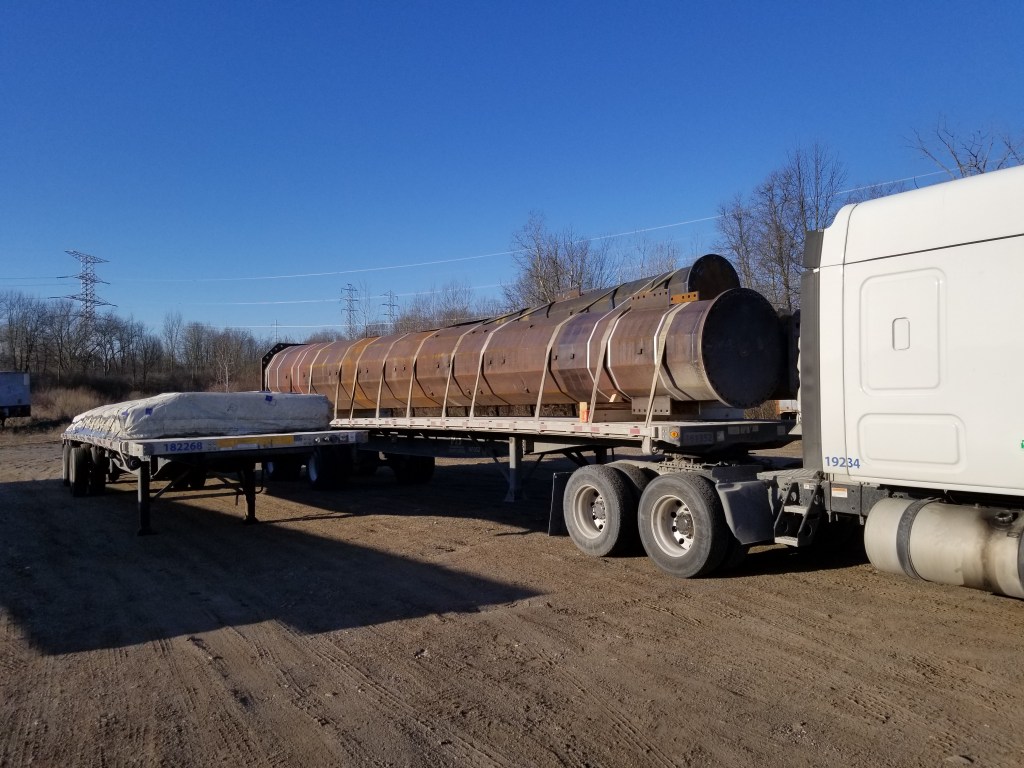
This past week, I joined my husband in his semi-truck while he did his job. We didn’t yet have a “shelter in place” order in Michigan, but we did have restrictions on gatherings and such. As a result, everything I was doing on a daily basis was cancelled. I work from home in property management, and our company had recently sent out a directive stating that all business was to be done by phone, text, or email. Aside from reading electrical meters (a job I easily completed the Saturday before we left), there was nothing for me to do in the office. All foster care visits are being done via Skype or phone call at the moment, and with unlimited WiFi on our phone plans and a tablet computer, not to mention an inverter which allows me to plug in a laptop to an automobile auxiliary outlet (or cigarette lighter if you’re as old as me), this was easily done from the truck as well. So I left behind the boring monotony of isolation on my own in order to spend some time with my husband.
There are a lot of marriages that are struggling right now. Couples having to isolate together and juggle working from home with all the childcare duties and housework is bringing out the worst in our relationships. More couples are filing for divorce because of the stress of being in confined spaces together. Truth be told, our marriage has been struggling off and on for the last 18 months. The stress of dealing with Inara’s mental illness along with the false allegations and CPS investigations and removal of our children and constantly living under the state’s microscope have all taken their toll. We have struggled to communicate, to appreciate each other, to be loving and kind….
If you were to listen to the prevailing wisdom of our society, what you’d hear is that we should divorce. After all, marriage is supposed to be all about us as individuals. If my marriage doesn’t fulfill me, if my marriage doesn’t make me happy, if my spouse doesn’t affirm my dreams, etc, etc, then the solution is to just pack it in, call it quits, and walk away. What a sad state of affairs we find ourselves in! And the sadder state of affairs is that couples caught up in the foster care system, if they were married in the first place, never stay married. To be fair, there are a lot of married couples who end up in the system due to legitimate abuse. In that case, a choice has to be made between the welfare and safety of the children and keeping the marriage intact. No one advocates for staying in an abusive marriage or continuing to live with a spouse who abuses you or abuses your children.
Our case is different. There is no abuse in our marriage. There was no abuse to our children. And as Christians, we made vows before God–we entered into a covenant–that we intend to keep. The system has never come across a couple that intends to stay married through all of this. They can’t seem to admit to making a mistake, so they’re looking for any and every little possible excuse to try to justify their actions. Unmarried young women with no children are making life-altering decisions and judgement call on the state of my marriage and my ability to parent. It’s scary when you come to think about it!
Does my marriage fulfill me? No. Not all the time. And you know what? It shouldn’t. My meaning, my fulfillment, my worth doesn’t come from my spouse. It doesn’t come from my relationship status. It doesn’t come from my circumstances. It comes from God! Does my spouse make me happy? No. Not all the time. And my happiness is not his responsibility. It’s mine. It’s a choice I make to be happy or not to be happy. Why should I put that burden on him? The truth is that both of us are incredibly human. We make mistakes. We sin. We have a lot of emotional baggage we haven’t completely dealt with. There’s a lot of refining work for God to do here in both of us individually and in us as a couple. For most people, that’s enough to call it quits, but marriage is supposed to be a visual representation to the world of what God looks like. Husband and wife are to have a close and intimate relationship just as Jesus has with the church…just as God the Father, God the Son, and God the Holy Spirit enjoys within the Trinity. If my focus is on my needs and my wants and myself, then I’m hardly going to be able to represent a selfless God.
Life as a trucker’s wife is hard. It’s almost as hard as the life of a soldier’s wife. Our husbands are gone. A lot. We develop routines to deal with the house and kids and all the responsibilities that normally fall on both parties in the couple when our husbands are gone. We handle all the appointments, all the scheduling, all the repairs, all the housework, all the finances (generally, speaking), etc. And then our husband’s come home, and we have to remember that they are a part of our lives and not resent them for throwing our schedules into a tailspin and for not knowing what’s going on and for being tired and not necessarily present–at least initially–and for struggling to integrate themselves into a household that for all intents and purposes runs successfully without them. That’s hard. It’s hard for me, and it’s hard for my husband.
I know my husband’s job is stressful. It’s dangerous, too. When we’re not at war, my husband’s job ranks as #1 dangerous job in America. And it’s a thankless job. My husband has to deal with people complaining about big trucks and dirty truckers. People assume he’s uneducated. They assume he’s ill-mannered. There are a lot of hurtful stereotypes out there about truckers. And there are a lot of temptations out there on the road. As a Christian, my husband is very aware that he may be the only Jesus the people he comes into contact with might see. A lot of his fellow drivers are amazed that he is faithful to me, and probably more amazed that I am faithful to him.
Knowing his job is stressful, I try to keep from talking to him about problems at home. Knowing that I’m doing a stressful job taking care of kids and running a house without him, my husband tries to keep from talking to me about problems on the road. As a result, there are times when there’s a lot of not talking. When you’re insecure and you have a lot of emotional baggage from past relationships, that not talking can make you suspect a lot of things. Suspicion can do a lot of damage. And that not talking can lead to other issues with communication. It’s hard enough to remember that we don’t all speak the same love language when we see our spouse every single day, but when we see them only on the weekends?….or maybe even every other weekend?….or once a month?
Getting away with my husband could be a risk. On his truck, we’re occupying a space that’s much smaller than a jail cell. We can’t get away from each other if tempers get heated. There are lots of other struggles on the road. Things like a lack of bathroom facilities, no safe parking, regulations about when he can drive/where he can drive/how long he can drive, and lack of healthy food options. With the COVID-19 precautions, these things are even harder to find. But for us, we always seem to do better in close proximity.
Here are some of the things I learned while on the road with my husband:
- My husband really does love me, even if he doesn’t always know how to show it. I feel loved when my husband speaks affirming words to me, but my husband struggles with expressing his emotions verbally. Instead, my husband made sure that anytime he bought himself a drink, he bought me one too. He bought me candy bars. He agreed to eat at a more expensive take out place one night rather than his standard Subway just so that I could have fried okra. As much as he complained about it, he made sure that we parked somewhere safe and with a bathroom nearby that I could use. He held my hand whenever we walked from the truck to the truck stop, and he put himself between me and the big trucks.
- My husband and I talk more freely when we’re together in his truck. Because I was on the road with him and sharing in the stress of driving and traffic and cars that tried to kill us by cutting us off, my husband was more relaxed in talking to me. He was willing to engage in deeper conversation with me, and he was less likely to take offense at my questions. We could have harder conversations about more controversial topics while we were driving, and that meant that we could leave the time right before bed for just vegging out and watching TV on his tablet together.
- The road poses a lot challenges to faith. The road is busy. It’s noisy. It’s distracting. My husband does his best to counteract this by listening to Christian music while he drives. It works for him, but it doesn’t work for me. Some of it comes down to the fact that he likes rap music, and he likes it loud with a lot of bass. Some of it comes down to the fact that I need quiet in general and time to read my Bible. The road didn’t offer a lot of opportunity. We drove from the time we woke up until we had to stop for the night 14 hours later. At that point, it was just a matter of eating, relaxing for an hour and going to bed to do it all again the next day.
- When I make sacrifices like this for my husband, I demonstrate my love for him. My husband didn’t believe that I really wanted to go with him. I think he worried that being on the truck would be too hard on me. He offered a lot of excuses before we left on why the plan to travel together might not work in case I wanted to back out. It was hard to take a step back and see this as a way of demonstrating his care and concern for me. From a fleshly perspective, I thought maybe he didn’t want me around. But we’ve traveled together before. I knew what I was getting into, and I was willing to go without a hot shower every day and running water just to spend time with him. This small gesture made my husband feel loved. I know because he took the time to right a Facebook comment to a friend about how wonderful a match we are. My husband doesn’t get romantic very often, so when he waxes eloquent about how wonderful a wife I am and how much he appreciates me, it matters a lot!
In marriage, it’s really easy to take the other person for granted. It’s easy to get caught up in our own needs and our own wants and our own head space. It’s easy to think that our spouse’s job is to make us happy or to fulfill us in some way. It’s really easy to forget that our spouse is human, just like we are. Sometimes, it’s really easy to get offended and think that the other person should think more like we think or communicate more like we communicate or be more like us. When that happens, we need to take a step back. We need to go back to 1 Corinthians 13 and remember what love really looks like. We need to look at ourselves and ask ourselves if we are being love to our spouse. We need to turn to God for fulfillment and for healing. We need to think the best of our spouse. And we need to forgive. Love covers over a multitude of sins…and without forgiveness, marriage is more of a struggle than it needs to be.
I challenge you to take a look at your spouse through God’s eyes. I challenge you to take a look at your marriage and ask yourself if it’s a good example of Jesus to the world. If it’s not, you might want to consider making whatever changes are necessary to get it there. And from this trucker’s wife, I challenge you to be a bit more considerate of those truckers out on the road. They are missing their families just so you can have the items you need for yours. Give them space on the road. Give them a kind word or maybe even a thank you when you run into them out and about.



 A Beautiful Mess