
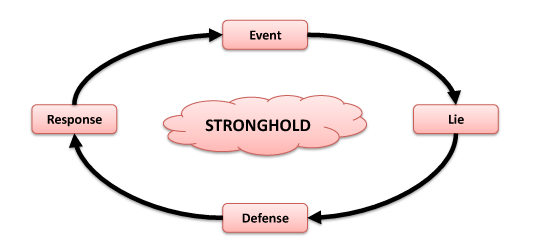
In my post, Who Are You Listening To?, I talked about finding freedom from strongholds. A stronghold is a reinforcing pattern in our lives that traps us in a pattern of thinking and behavior. It’s basically an area of our life that acts as an open door for Satan to influence us, torment us and have power through us. Strongholds give Satan the right–the legal authority–to enter our lives in that area. Because strongholds are reinforcing patterns of behavior, they develop over time. We have a negative experience. That negative experience leads us to agreeing with a lie of the enemy. As we come into agreement with that lie, we make a judgement. This judgement might cause us to harbor unforgiveness in our hearts. As a result of this judgement, we may make an inner vow. We choose a defense, a way of protecting ourselves from the negative event/experience. Others respond to our defenses. Their negative response can reinforce our original negative experience or become its own negative experience, and the pattern continues to repeat itself.
I want to focus in on the judgement and inner vow portions of constructing a stronghold in our lives. Deconstructing these strongholds and breaking our agreements with the lies we have believed is the first step toward freedom in Christ. A part of that is renouncing our judgements and getting rid of any inner vows we may have made as a result of those judgements. Hebrews 12:15 (NASB) says: “See to it that no one comes short of the grace of God; that no root of bitterness springing up causes trouble, and by it many be defiled…” A judgement can often lead to this root of bitterness. It definitely causes us to fall short of the grace of God, so we want to be sure that we deal with this area of our lives as soon as we become aware of it.
What is a judgement? A judgement is a generalized negative decision and expectancy against something or someone. We can make judgements against an individual or against an entire group of people. We can make judgements against ourselves. We can make judgements against God. Luke 6:37 (NLT) warns us about the dangers of making judgements: “Do not judge others and you will not be judged. Do not condemn others, or it will all come back against you. Forgive others, and you will be forgiven.” Matthew 7: 1-5 (NIV) also talks about judging others: “Do not judge, or you too will be judged. For in the same way you judge others, you will be judged, and with the measure you use, it will be measured to you. “Why do you look at the speck of sawdust in your brother’s eye and pay no attention to the plank in your own eye? How can you say to your brother, ‘Let me take the speck out of your eye,’ when all the time there is a plank in your own eye? You hypocrite, first take the plank out of your own eye, and then you will see clearly to remove the speck from your brother’s eye.“
It isn’t that we aren’t to judge anything. Obviously, we need to make judgements every day. It’s the manner in which we go about making those judgement calls that are important. The Bible tells us that God is to be our source. He’s not only the source of everything we need, He’s also supposed to be the source of our determinations about right and wrong. John 9:39 (NLT) says: “Then Jesus told him, “I entered this world to render judgment–to give sight to the blind and to show those who think they see that they are blind.” When we think we know right from wrong and we look to ourselves as the final source of judgement, we are committing the sin of idolatry.
Idolatry sets anything else in God’s place. It doesn’t let God be God. When we form judgements from our own power of reasoning, we remove God’s place and replace it with our own thoughts and actions. When we pass a judgement on a person or a situation, we place a label on them. We put a label on that says who they are based on how we see them. When we’ve built a judgement about another person, we have closed the door to what God wants to say about them. When we look at a person or a situation, we only see a small sliver of the truth. We only know a small piece. God is the only one who sees the full context. As a result, God is the only one who has enough information to judge things rightly.
Proverbs 23:7 says, “For as he thinks in his heart, so he is.” When we place a label on another person, it affects how we see them. It changes us, and it changes how we live our lives. We can form these judgements/labels from our own experience, or they can be learned from others. A great example of this is racism. Racism is a judgement about a group that is learned from others. When we come into agreement with a judgement or label, we are really coming into agreement with Satan. Satan wants to sow division and discord, and an excellent way of doing that is through judgements. Breaking our agreement with judgements and labels puts us in a place to hear God. We hear how He views the person or the situation. Hearing God removes the power of the label to rule our view. Our yesses should be God’s yesses, and our no’s should be God’s no’s. Judgements can lead us to inner vows.
What is an inner vow? An inner vow is a determination set in our mind and heart to protect us from pain. It’s a promise that we have made to ourselves. An inner vow is absolutely swearing to yourself something that you feel and believe you are obligated to carry out. “Always” statements and “never” statements are an indication that an inner vow may be at work in our life.
An inner vow gives us:
- A false sense of self-protection against future rejection or pain
- A false sense of hope for the future
- An agreement with the devil
When we make inner vows, we are partnering with the enemy and showing a lack of trust in God’s love for us and in His ability to comfort us, protect us, and be Lord in our life. Inner vows put all the burdens for transformation on us, and we are powerless to effect that level of change in our lives. Matthew 5:33-37 warns us about making vows: “Again, you have heard that it was said to the men of old, ‘You shall not make false vows, but you shall fulfill your vows to the Lord [as a religious duty].’ But I say to you, do not make an oath at all, either by heaven, for it is the throne of God; or by the earth, for it is the footstool of His feet; or by Jerusalem, for it is the city of the Great King. Nor shall you make an oath by your head, for you are not able to make a single hair white or black. But let your statement be, ‘Yes, yes’ or ‘No, no’ [a firm yes or no]; anything more than that comes from the evil one.” These are the places where we can unconsciously partner with the devil in our lives.
Identifiers of Inner Vows:
- Can’t commit to relationships or other commitments
- Can’t trust
- Can’t accept help from others
- Can’t relax
- Have a strong desire to control others
- Can’t break a pattern of behavior
Examples of Inner Vows:
- I’ll never by like my father/mother.
- I’ll never let anyone hurt me again.
- I’ll never be poor again.
- I’ll never be able to trust or have confidence in (insert person or group of people here).
So what do we do? We need to go to God and ask him to reveal to us any judgements or inner vows we may have made in our lives. Once God has shown us the existence of a judgement, we must repent for the idolatry of not leaving God in the position of controlling how we view things. We must repent for coming into agreement with the judgement. We also need to repent for the inner vow we have made. We need to ask God to reveal to us the truth of what happened or the truth about the person/group of people. We need to forgive any person involved in the circumstances surrounding the negative experience, where it all started. We also need to forgive ourselves for making these judgements and vows. Then we need to confess that we are coming into agreement with God’s truth about the situation and submit our emotions to Him.
Lord, You’ve helped me to identify the roots of judgement and inner vows. I want to repent for making these against myself, against others, and against you. I renounce those inner vows in the name of Jesus. Lord, I pray that You release Your grace, Your mercy, Your healing and a revelation of Your heart. Today, I put a stake in the ground of new beginnings; I am going to refuse to allow the Enemy to provoke me into hatred, bitterness, and a hardened heart. Lord, retrain my mind so I can hear your voice about what you say and about who I am in You. Please help me exhibit the fruit of the Spirit and not my flesh.
It’s important that as we approach negative experiences, we allow God to speak to us in the moment. Pause when you feel pain or hurt and ask God for an explanation of what is going on and what is at play. When you ask God, He will speak to you. He can speak in lots of ways, but it will be a way that you can hear and understand. If God doesn’t speak to you in that moment, it probably means that the issue isn’t yours. Don’t take responsibility for it. Remember that God won’t air other people’s dirty laundry, so if He doesn’t show you your part in the situation, then let it be.
Asking God for His take on things can de-escalate conflicts in your relationships, help you hold on to God’s righteous judgements and His truth, and prevent you from making judgements and inner vows of your own. We don’t want to build up strongholds in our lives or give territory to the enemy! We want to live lives of freedom and victory in Christ Jesus!
 A Beautiful Mess